Posts

President-elect Joe Biden Introduces His "American Rescue Plan"
Image
Just about a month after the second relief bill was passed, President-elect Joe Biden released the details of the next round of stimulus for COVID-19 relief. This plan is quoted at the steep price tag of $1.9 trillion and is titled the American Rescue Plan. Biden will look to pass the plan in the form of two bills with the first being a more immediate solution to the economic anxieties caused by the pandemic and the second being a bill to attack longer-term goals of “creating jobs, reforming infrastructure, combating climate change and advancing racial equity.” Here is what’s on his wish list: Direct payments of $1,400 to Americans (to get to $2,000 in direct payments including the December $600 payment). Federal unemployment benefit to $400 a week and extending through Sept. Extending restrictions on evictions and foreclosures through Sept. $350 billion in state and local government aid. $170 billion to K-12 schools and higher education. $50 billion to COVID-19 testing efforts. $20 b...

Political Polarization Intensifies with Another Impeachment Along Party Lines

Image
 It has happened again. On January 13th, 2021, President Donald Trump was impeached by the House of Representatives for a second time in his term (and seven days away from the end of that term). The impeachment was in response to the Capitol insurrection last week and the role he played in the escalation of the events that day. While it may have seemed like a clearer reason for impeachment than the first round, the vote was still almost entirely divided down party lines. In the first impeachment, the House vote was 228-193 in favor, and in the second, slightly closer at 232-197 in favor. Ten Republicans crossed party lines to vote in the affirmative which felt like a major bipartisan shift, but in reality, it wasn’t. Both votes highlight political polarization that has only heightened in the last four years of President Trump’s term. On several issues, Republicans and Democrats have become more polarized, in the public and in Congress. Views on protesting have shifted with 43%...

Metal Demand Has a Bright Future in 2021 and Beyond

Image
One of the stories of 2020 was the immensely impressive rise in Tesla’s (TSLA) stock price. Shares of the electric car company rose about 720% as it made headlines month after month and eventually catapulted Elon Musk to become the richest man in the world at the beginning of 2020. The hype surrounding Tesla is representative of a greater overall trend of innovation in green energy. A trend that has transformed from being driven by speculation of what it could become to being driven by demand for the new products being created. S&P author Jim Wiederhold hints at this in his “Refl ecting on the Inflections Points of 2020” reviewing S&P GSCI Sector Commodities and their performance over 2020. The article reports that S&P GSCI Precious Metals and S&P GSCI Industrial Metals were the best performing of the 6 indexes with Precious Metals up over 20% and almost 70% higher than the worst-performing Energy Index. Some Precious Metal highlights were gold and palladium up above 2...

What Happened to That US-China Trade Dispute?

Image
 China-US trade tension once was one of the primary economic topics during President Trump’s presidency as his fleeting diplomacy with them tossed financial markets into disarray. In 2020, as far as the media was concerned, trade tensions took a backseat to the impending COVID-19 crisis which spawned in late February and early March. Instead, after the January 2020 Phase One Trade deal was in place, conversations trailed off as the focus moved to public health. While everyone was distracted, the US-China Economic Security Review Commission continued to monitor progress in the de-escalation of trade tensions which seems to have occurred.   As of October 2020, US exports to China were up 66% year-over-year at $14.7 billion. The surge in exports set a new monthly record for US exports which had historically never been higher than $12.6 billion (record set in October 2016). The large growth led to a -14.1% drop in the trade deficit with China at a time when the US’s overall trade...

Civil Unrest, A Rising Threat to the 2021 Economy

Image
 On January 6th, 2021 during the Senate's certification of the 2020 election results on the steps of the Capitol building, protests by Trump supporters escalated into a siege. The crowd moved to the steps of the building and eventually forced their way inside. For a couple of hours, they remained there causing chaos while law enforcement moved slowly. Amidst the invasion, a female protester was shot and killed. The day will be remembered in sadness after a year of intensifying political polarization exacerbated by an even more divisive election. With two weeks until the inauguration of Joe Biden, political uncertainty lingers as President Trump continues to refuse to concede the election. The uncertainty was likely compounded by the COVID-19 pandemic which has spurred lockdowns and more polarization along political party lines. The economy has limped alongside supported by stimulus bills and liquidity injections. An IMF report found significant evidence that major pandemics have t...

What's in the $900 Billion Relief Plan?

Image
The second round of COVID-19 relief has been passed. Congress closed negotiations on the huge bill that would cost around $900 billion in December before 2020 ended. The price tag this round is about half of the $1.8 trillion CARES Act legislation (which was down from an expected $2.3 trillion at the time) but has still been cited as not being big enough. Here's what's in the bill  (a further breakdown from Sullivan & Cromwell ):  $300 extra per week in unemployment insurance as well as an extension of Pandemic Unemployment Assistance and Pandemic Emergency Unemployment Compensation. $284 billion into Paycheck Protection Programs and $20 billion more in grants for companies in low-income areas and money for community-based and minority-owned lenders. $600 in direct payments to individuals who made up to $75,000 and couples who made up to $150,000 with payments down to nothing for individuals who make $99,000 or more and couples who make $198,000 or more. $25 billion into ...

2021 Outlook Review

As 2020 comes to a close, a new year in 2021 demands our attention. The top institutions have released their takes on what the next year will look like financially as one of the most dramatic years comes to a close. Global economic and financial outlooks have the tough task of reviewing the cornucopia of troubling events from 2020 while looking forward to what 2021 could bring. Some central themes can be picked out in the following annual outlooks but also key differences. In the decisions of what to keep in and out of the report, we can see what is expected to be the driving economic forces in the new year. Vanguard Wells Fargo BlackRock Lazard Merrill Lynch JPMorgan Citi The two themes most dominant in all the outlooks were the easing of COVID-19 and a continuation of easing in central banking policy. Every report saw these as driving forces in 2021 as they were in 2020, and of course, it's no secret that these would be chosen to guide the discussions. More specifically, COVID-19...

When Tech Diverges...

Image
The stock market has been on a tear. Despite a global pandemic reemerging in the second half of the year, investors seem to be okay with buying on expectations of an improvement in the economy in 2021 because that seems to be the only real reason for bulls to win out in the market. Unemployment is still at excessive levels with more than 700,000 claims for unemployment being filed every week (though continued claims are slowly edging lower). The bounce in output growth was strong over the summer but momentum seems to be slowing in retail sales, manufacturing, and industrial output. Despite this, indexes reach all-time highs. That is even more so true for the Nasdaq which has rocketed past its pre-pandemic highs. The index tracking the top tech companies seems to have left the S&P 500 and the Dow Jones Industrial Average in the dust. Based on trading from February 24th to November 27th, the Dow and the S&P 500 have grown 6.97% and 12.79% while the Nasdaq has surged 32.37%. Some ...

Health Insurance Data: 2019 Update

Image
In the upcoming election season, Democrats and Republicans will continue to go head to head over various hot button topics as they jostle for control of the White House and Congress. Healthcare will be one of those topics primed for debate amongst candidates as discussions over "Medicare for All" continue to take center stage. In those debates, potential voters will hear the latest data rattled off as candidates look to bolster their talking points. Those data points will likely come from the Census Bureau's latest edition of the "Health Insurance Coverage in the United States" report which highlights their 2019 findings. Here are some highlights.  The number most likely to be taken from this report is the total number of individuals without health insurance in 2019, and it's a lot more complicated than just a number. The Census Bureau cites two different numbers from two different surveys in the report, the Current Population Survey 2020 Annual Social and E...

Can Real Estate Supply Keep Up with Hot Demand?

Image
Economic Report Monitor #59 August 14th, 2020 New residential figures for July came out and provided a fresh but of optimism for a strong economic recovery. Housing starts jumped 22.6% in July, another huge bounce, leading to a July total 23.4% higher than last year. The 1.496 million unit starts that beat expectations of 1.24 million heavily.  It was multifamily home units that carried the number in July with a 56.7% increase in that category to 547,000 units. The number is the strongest since January 2020 (619,000 units) and is 67.8% higher than a year ago. Single-family homes were up just 8.2% to 940,000 units, slightly lagging the 1,034,000 units in February. Since single-family homes are typically more in demand, it's slightly concerning to see that category lag the overall trend. Single-family home demand recovery is stronger than supply recovery The NAHB/Wells Fargo Housing Market Index report pointed to hot demand for single-family homes coming out of the bottom of the C...

Consumer Spending Looks Strong Despite Pandemic

Image
Economic Report Monitor #59 August 14th, 2020 Retail sales in July confirmed what most people were expecting. The economic recovery has slowed with a resurgence of COVID-19 cases stalling reopening processes. Overall, sales increased just 1.2% after they surged 8.4% in June and failed to meet expectations of 2.3% that economists surveyed by Dow Jones suggested . Despite growth being muted in July, sales for the first 7 months of 2020 are down just -2.1% from the same period in 2019. Excluding motor vehicles & parts and gasoline stations, that number is actually 0.2% higher. From CNBC Motor vehicles & parts also dragged July retail sales lower with a -1.2% drop for the month. Retail sales without that category were 1.9% and closer to expectations. Building material & garden equipment & supplies dealer also dragged sales with a -2.9% drop itself. Furniture stores were flat at 0.0%. These numbers might point to further pain for durable goods categories which was most inte...

COVID-19 Unemployment Still Elevated but Mostly Temporary

Image
Economic Report Monitor #58 August 7th, 2020 Following the disappointing number on Wednesday, the Bureau of Labor Statistic's official report of the employment situation came out today. In a similar fashion, the BLS report showed a slower recovery in July as only 1.8 million jobs were added with the unemployment rate falling just 0.9% to 10.2%. While this beat expectations of about 1.6 million, it confirmed that a V-shaped recovery in the labor market is unlikely to materialize. From MarketWatch The number of unemployed individuals dropped by just 1.4 million to 16.3 million but is still up by about 10.6 million since February. Most of the COVID-19 losses remain as the number of individuals that have been jobless for 15 to 26 weeks rose by 4.6 million to total 6.5 million. Fresh job losses that occurred in the last 5 weeks are about 3.2 million, with just 364,000 added in July, suggesting the contraction in employment has slowed significantly. Most of the job additions were tempo...

ADP Employment Disappoints, But Small Businesses Notch Jobs Gain

Image
Economic Report Monitor #57 August 5th, 2020 The first of the jobs numbers came out today for July as the ADP Employment Report  was released before the market opened. The number largely disappointed with an increase of 167,000 in private payrolls, well below the June reading of 4.314 million and the expected number for July of 1.5 million. Based on the report, it seems that the resurgence of cases has influenced reopening processes to slow and in some cases stop completely. Larger companies lead the gains adding 129,000 jobs in July with medium businesses shedding -25,000 and small businesses adding 63,000. Small businesses probably only outperformed medium businesses because reopening processes are likely favoring operations with small numbers of employees working at a time. Businesses with only 1-19 employees, typically the most economically sensitive, added 45,000 jobs, the second-most behind businesses with 1,000+ at 111,000. The sectors that added the most jobs were in the s...

Breaking Down the Worst Quarterly GDP Decline in US History

Image
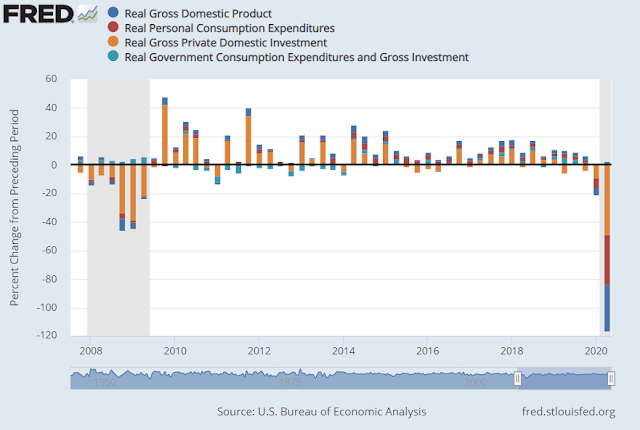
Economic Report Monitor #56 July 30th, 2020 From FRED The long-awaited 2020 Q2 GDP came out today after months of deliberation on how the COVID-19 outbreak and the lockdown would initially impact the economy. Consensus estimates suggested that 2020 Q2 GDP would fall about -34% from the previous quarter in the largest drop in economic output in history. The official advance estimate came in at -32.9% just above expectations but still the worst quarterly GDP data point ever reported. Stocks saw mixed reactions as the Dow (-0.85%) and the S&P 500 (-0.38%) finished lower while the Nasdaq (0.43%) actually saw a gain. The 10-year Treasury yield dropped back to its low near 0.55% as investors continued to move away from risk. Personal consumption, which has been a strong driver of GDP growth in the past, tanked -34.6% in the second quarter with service spending seeing the largest drop at -43.5%. Goods expenditures fared slightly better at -11.3% as the goods economy adjusted to the new C...

Consumer Expectations Sour as Market Turns Lower

Image
Economic Report Monitor #55 July 28th, 2020 Consumer confidence is an important indicator of consumption and overall economic health as the US economy as measured by GDP is heavily driven by consumption. Since the beginning of the COVID-19 pandemic, current measures of consumer confidence in the two main surveys for the indicator, the Conference Board Consumer Confidence Index and the University of Michigan Survey of Consumers, have trended near all-time lows comparable to the 2008 financial crisis. However, readings of expectations typically fared better as the initial evaluation of consumers was that the lockdowns and pandemic would be temporary. Almost 5 months later, those trends have begun to reverse. In today's Conference Board Consumer Confidence Index July  report , the index reported a drop from 98.3 in June to 92.6 in July with a large deterioration in expectations. The current conditions index continued to improve as reopening measures assuaged concerns of financial inst...

Market Drops on More Tepid Economic Data

Image
Economic Report Monitor #54 July 23rd, 2020 As the pandemic continues to add new cases to the overall count, the market continues to struggle with an economic condition that is not improving. In another day of selling off, major indexes fell -1 to -2% with the Nasdaq leading the drop at -2.29%. Safe havens like gold and silver flourish as optimism stales and valuations continue to be tough to justify. The  jobless claims  reports today is just one example of that as initial claims increase for the first time since it seemed to have peaked in April. At 1.416 million, an additional 109,000 claims were added last week as the number of individuals beginning the unemployment process remains above 1 million for another week. Continuing claims did drop though as the insured unemployment rate fell to 11.1% and 1.107 million individuals stop receiving unemployment insurance. States where COVID-19 cases are resurging, Florida, Georgia, and California, are the main culprits for the incre...

Jobless Claims Struggle to Fall Despite Bullish Spending Seen in Retail Sales

Image
Economic Report Monitor #53 July 16th, 2020 The previous choppy bullish trading session was reversed into a choppy bearish trading on Thursday as indexes headed for a loss. The Nasdaq, down -0.73%, underperformed the Dow Jones Industrial Average and the S&P 500 again, down -0.50% and -0.34%. Over the last 5 days, information technology stocks have dropped -2.75%, the most in a list of 11 sectors, with energy leading at 5.57%. This differs greatly from the YTD performance where information technology is up 17.51%, well above the -37.78% movement in energy. It seems money might be avoiding the sectors which have benefited the most in the rebound as a resurgence could crash them harder. Economic reports confirmed the shaky status in a mixed bag of data points. Most notably, initial jobless claims came in above 1 million once again at 1.3 million, just 10,000 lower than the week before. Overall insured unemployment also fell but again only at a slow pace. Totaled continued claims wer...

More Economic Reports Point to a Bottom, but a Recovery Continues to Look Father Off

Image
Economic Report Monitor #52 July 15th, 2020 A choppy day in trading ends with indexes higher about 0.5% to 1.0%. Nasdaq once again lagged the other major indexes as tech stocks look to slow from their fast pace. Treasury yields remain low despite hopes that Moderna's coronavirus vaccine would continue to show positive results. The dollar reaches towards YTD lows. Consolidation looks to be the trend as bad news continues to outweigh the good news, and the recovery pauses as investors look for a reason to buy. The latest Empire State Manufacturing Index for July 2020 suggested manufacturing activity has stabilized in NY. The general business conditions index grew to 17.2 in July marking its first positive reading since February. While the index values have completed a V-shaped recovery, most categories point to just a stabilization. Despite the indexes jumping to near-term highs, only a net 17.4% and 15.2% reported seeing higher new orders and shipments. Unfilled orders were gridloc...